
According to Prismark's 2017 statistics, FPC finds its primary application in consumer terminals like consumer electronics, smartphones, and tablet computers, accounting for 29%, 19%, and 22% of FPC applications, respectively. However, given the rapid updates and iterations in the electronics industry, the advancements in consumer electronics with the emergence of 5G, and the technological breakthroughs in various downstream applications like artificial intelligence and intelligent driving in the post-5G era, we anticipate that the application field of FPC will not be limited in the future!
1. Smartphone Shipments Bottom Out as 5G+
Global smartphone shipments experienced weakness in 2017, which further intensified in 2018, reaching a low of 1.405 billion units.
However, the advent and widespread adoption of 5G technology will bring significant changes to the smartphone industry.
Simultaneously, continuous innovation in smartphones, including advancements in cameras, under-screen fingerprints, and 5G networks, will address the issue of limited innovation.
As a result, we anticipate a future recovery in smartphone shipments, fueled by the combination of 5G and innovative features, leading to a new wave of phone replacements.
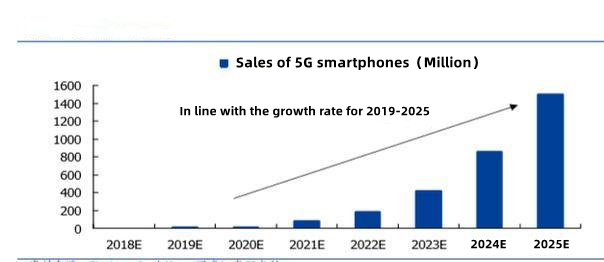
2.Increasing Usage of FPC in Stand-alone Machines Drives Growth
The usage of FPC in stand-alone mobile phones is experiencing continuous growth, which has a direct impact on the total usage of FPC.
When examining the past usage of FPC in both the Apple and Android camps, we observe a steady increase in FPC usage in individual devices.
Can this trend of increasing stand-alone FPC usage continue?
The answer is yes.
To understand why FPC is essential and why it is a necessary trend in smartphones, we must consider its characteristics: lightweight, thin, and flexible. FPC can partially replace rigid PCBs, allowing for more space within the limited internal area of smartphones for other electronic components.
Another question arises: Will the internal space of smartphones become tighter and unable to accommodate additional components? The answer to this question also determines the future growth of FPC usage.
As we observe the increasing size of camera modules and batteries in smartphones, driven by optical innovations and the widespread adoption of 5G, the internal battery capacity of mobile phones needs to increase to support longer standby times. This further squeezes the limited space within the device, leading to a higher demand for FPC.
Hence, the usage of FPC in previous-generation models has seen an increase, and this trend is expected to continue as mobile phone technology advances.
3.Increasing FPC Usage in Mobile Phones Driven by Innovation
In our previous article, we discussed the growing usage of FPC in consumer electronics, driven by increased demand and innovations in mobile phones, as internal space becomes increasingly limited.
New FPC demands have emerged, such as for camera modules, under-screen fingerprint recognition, and folding screens, as mentioned in our previous report.
Recently, Vivo and Huawei unveiled flagship models featuring side virtual buttons: Vivo NEX 3 and Huawei Mate 30 Pro.
By comparing the physical side buttons of the iPhone XS Max with the virtual buttons of the Vivo NEX 3, we can see that the FPC used in the iPhone primarily connects button-related components, while the virtual buttons on the Vivo NEX 3 are realized through a complete FPC attached to the side of the phone.
This introduction of virtual buttons invisibly increases the amount of FPC used in smartphones.
By examining XYZone’s disassembly video of the Huawei Mate 30 Pro, we can observe the crowded internal space, with the motherboard shaped like an “axe” due to the layout of the rear four-camera module and the battery. The space originally occupied by physical side buttons is now at risk.
The replacement of physical buttons with FPC-based virtual buttons helps save internal space in smartphones. FPC solutions are smaller in volume compared to pressure capacitors, inductors, or MEMS solutions. Additionally, FPC assembly and processing for pressure sensing solutions are more flexible and straightforward.
From under-screen fingerprint recognition to the advent of folding screen smartphones and the introduction of innovative virtual side buttons, it is evident that FPC usage inside smartphones is gradually increasing. Whether due to the need to replace traditional PCBs or other components, or driven by continuous innovations, FPC plays an expanding role in smartphone technology.
4.Increasing Usage Corresponds to Growing Value of FPC
As the usage of FPC continues to rise, its value also increases, particularly in specialized applications such as the soft-rigid combination board for under-screen fingerprint modules, the larger-area LMC FPC for folding screens, and the newly introduced virtual side buttons.
The value of FPC used for pressure sensing in virtual side buttons, as seen in Vivo’s NEX 3 and Huawei’s Mate 30 Pro, surpasses that of non-modular FPCs typically used in mobile phones.
Regarding FPC used in modules, the current price for small and medium-sized LCM (LCD display module) FPCs ranges from 1800-2000 RMB. With the growing adoption of OLED and the corresponding shift away from LCD, the technical complexity may increase, necessitating multi-layer FPCs, further driving up their value.
If folding screen smartphones gradually gain popularity in the consumer market, the amount of FPC used in the folding screen (screen only) will increase in tandem with the expansion of screen size, thereby driving the value of FPC in screen modules.
Investment Advice
Looking ahead, the consumption and comprehensive value of FPC inside mobile phones, whether in the Android or Apple camps, is expected to steadily increase.
Furthermore, in the 5G era smartphone market, we anticipate a new wave of replacements. The increased value of individual devices aligns with the dawn of a new era in the mobile phone industry. Consequently, the Chinese FPC industry is poised to experience rapid growth, driven by the concept of domestic substitution.