
The raw materials for Flexible PCB include flexible copper clad laminate (FCCL), covering film, adhesive film, and copper foil, along with various classifications of FPC copper foil.
Key Raw Materials for Flexible PCB Production
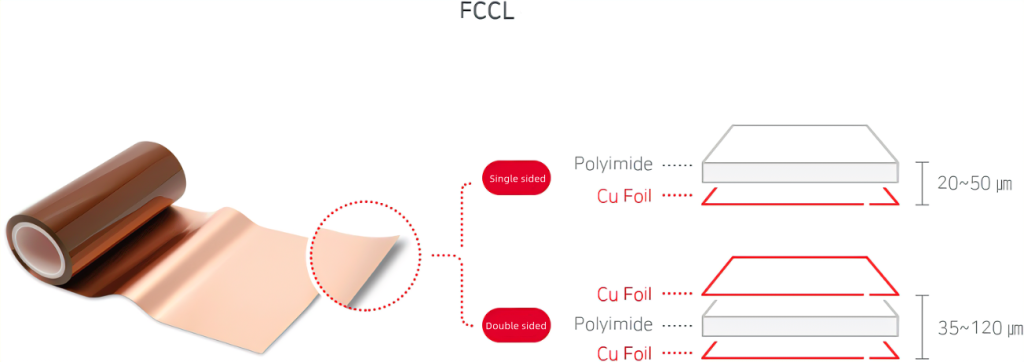
1. Flexible Copper Clad Laminate (FCCL)
According to whether one side is covered with copper foil or both sides are covered, it is termed single-sided copper clad laminate or double-sided copper clad laminate. Additionally, based on the difference between copper foil and sheet film, it is classified as glued copper clad laminate or copper-plated glued laminate.
The common sheet films for flexible copper clad laminates include polyimide film (PI), polyester (PET), polyethylene 2,6 naphthalate (PEN), liquid crystal display polymer (LCP), and other molecular material plastic films. In all PCB circuit boards, the copper clad laminate plays a crucial role in providing three levels of conductivity, insulation, and support.
The characteristics, quality, process performance, manufacturing cost, manufacturing level, etc., of both FPC and PCB circuit boards throughout the production process heavily rely on the properties of the copper clad laminate.
2. Covering film
It is composed of organic chemical plastic film and adhesive. The cover film’s role is to preserve a portion of the electrical conductor in the flexible power circuit that has already been processed. Adhesive films come in various types of sheet films, adhesives, and thickness specifications.
Some FPCs (Flexible PCBs) opt not to use a cover film on the surface, instead choosing to apply solder resist to manage costs.
3. Adhesive film
It is produced by applying adhesive to both sides or one side of a sheet film. Some adhesive films lack a pure adhesive layer on the sheet. These films come in various types of adhesives and thickness specifications.
Adhesive film is utilized for bonding and insulating the layers of solid wood multi-layer board virtual beams.

4. Copper foil
There are electrolytic copper foil and rolled copper foil, each available in various thickness specifications. Copper foil is utilized for the surface conductor layers in the production of multilayer printed circuit boards.
Additionally, some FPC (Flexible Printed Circuit) boards incorporate stiffener materials, such as metal sheets, plastic sheets, resin films, and epoxy glass substrates. The purpose of the reinforcing material is to strengthen specific areas of the flexible circuit board for support and fixation. It’s important to note that not all FPCs are equipped with these materials, and they are not included in the unit consumption standard.
The above provides a detailed overview of the primary raw materials for FPC flexible circuit boards, as summarized by Mondo Technology. We hope this information proves helpful! For any inquiries regarding Flexible PCB Materials, feel free to consult Mondo Technology at no cost. Specializing in the production and assembly of various types of FPC circuit boards, Mondo Technology offers FPC prototyping, mass production, and SMT services, with a focus on high-precision FPC circuit boards.
Flexible PCB Copper Foil Classifications
The types of Flexible PCB copper foil include:
- Based on Flexible PCB thickness, it can be categorized into thick copper foil (greater than 70μm), conventional thickness copper foil (greater than 18μm but less than 70μm), thin copper foil (greater than 12μm but less than 18μm), and ultra-thin copper foil (less than 12μm).
- According to the surface condition, it can be classified into single-sided treated copper foil (single-sided rough), double-sided treated copper foil (double-sided rough), smooth-treated copper foil (double-sided smooth), and very thin copper foil (VLP copper foil), among others.
- Single-sided treated copper foil (single-sided rough): This type is the most widely used among electrolytic copper foils. It is highly productive and finds extensive application in the manufacturing of copper-clad laminates and multilayer boards.
- Double-sided treated copper foil (double-sided rough): Primarily used in multi-layer circuit boards with fine lines, this type has a lower-profile surface treatment. When laminated with the substrate, it forms a copper-clad laminate, maintaining high precision lines after etching. The demand for this copper foil is increasing.
- According to the scope of application:
- (1) Copper Clad Laminate (CCL) and Copper Foil for Printed Circuit Boards (PCB): CCL and PCB represent the most widely used fields for copper foil. PCB has become an essential component in most electronic products for circuit interconnection. Copper foil, a key material for PCBs, serves as support and interconnect components in electronic products. Currently, electrolytic copper foils dominate applications in the CCL and PCB industries.
- (2) Copper Foil for Lithium-Ion Secondary Batteries: Due to its good conductivity, soft texture, mature manufacturing process, and relatively low price, copper foil is the preferred choice for negative electrode current collectors in lithium-ion batteries. It is coated with negative electrode materials such as graphite and petroleum coke.
- (3) Copper Foil for Electromagnetic Shielding: Primarily used in fields requiring electromagnetic shielding, such as hospitals, communications, and military applications. Electromagnetic shielding copper foil is mainly electrolytic copper foil due to the limitations of rolled copper foil width.
- According to the production method, it can be divided into electrolytic copper foil and rolled copper foil.
- (1) Electrolytic Copper Foil: Formed by depositing copper ions in the electrolyte on a rotating cathode drum made of smooth stainless steel or titanium. The side close to the cathode roller is smoother (smooth surface), while the other side presents a rougher concave-convex crystal structure (rough surface). Electrolytic copper foil is commonly used for rigid copper clad laminates due to its columnar crystal structure. Technical performance requirements for electrolytic copper foil include thickness, standard quality, appearance, tensile strength, peel strength, high-temperature oxidation resistance, mass resistivity, and additional requirements in some regions.
- (2) Rolled Copper Foil: Generally made from copper ingots through hot pressing, tempering, toughening, oxide removal, cold rolling, continuous toughening, pickling, rolling, degreasing, and drying processes. It is rarely used for rigid copper clad laminates but is suitable for flexible copper clad laminates due to its larger bending resistance and elastic coefficient. Rolled copper foil has higher copper purity (99.9%), smoother rough surfaces, and is used for high-frequency, high-speed signal transmission substrates and thin-wire printed boards. Recent innovations include high-toughness rolled copper foil and oxygen-free calendared copper foil, each serving specific applications such as flexible boards or high lead strength requirements in TAB.
- Other Types of Copper Foil:
- (1) Self-adhesive Copper Foil: This category includes both self-adhesive copper foil (ACC) and self-adhesive copper foil (RCC). Self-adhesive copper foil involves roughening electrolytic copper foil and then applying a resin layer on the roughened surface. It is primarily used in the manufacturing of paper-based copper clad laminates.
- (2) Carrier Copper Foil: In the production of ultra-thin copper foil, a metal support foil of a specific thickness serves as the cathode, where copper is electrodeposited. The plated ultra-thin copper foil is heated along with the plated layer on the metal foil supporting the cathode. This foil undergoes pressing, curing, application on an insulating material sheet, and chemical or mechanical stripping of the metal support foil. The resulting ultra-thin copper foil is referred to as carrier copper foil.
- (3) Untreated Copper Foil: IPC-4562 defines two types of untreated copper foil. One is copper foil (code N), untreated for adhesion enhancement and rust prevention; the other is copper foil (code P), untreated for adhesion enhancement but treated to prevent rust. The latter is widely used, such as in copper foil for certain lithium-ion batteries and shielding copper foil.
- (4) Low Profile Copper Foil (LP Copper Foil): Primarily used in multi-layer circuit boards, LP copper foil requires a surface roughness smaller than that of ordinary copper foil. IPC-4562 specifies that the profile on both sides of LP copper foil should not exceed 10.2 microns.