
History of PCB in the world
Printed circuit boards were first used in radio devices by their Austrian creator, Paul Eisler, in 1936. In 1943, the Americans mostly used the technology in military radios. In 1947, the American Aeronautics and Astronautics Administration and the American Bureau of Standards initiated the first technical discussion of PCBs. In 1948, the United States officially approved the invention for commercial use. In the early 1950s, due to the adhesion strength and welding resistance of CCL copper foil and laminate solving the problem, stable and reliable performance was realized along with the industrial production, making the copper foil etching method become the mainstream of PCB manufacturing technology and single panel production began.
In the 1960s, the perforated metallized double-sided PCB was realized and mass production was achieved. In the 1970s, multilayer PCB developed rapidly, continuing toward high precision, high density, small wire holes, high reliability, low cost and automated continuous production. In the 1980s, surface-mounted printed boards (SMT) gradually replaced plug-in PCBs and became the mainstream of production. Since the 1990s, surface mounting has been further developed from flat package (QFP) to spherical array package (BGA). Since the 21st century, high density BGA, chip level packaging and organic laminate material as the substrate of multi-chip module packaging printed boards have been rapidly developed.
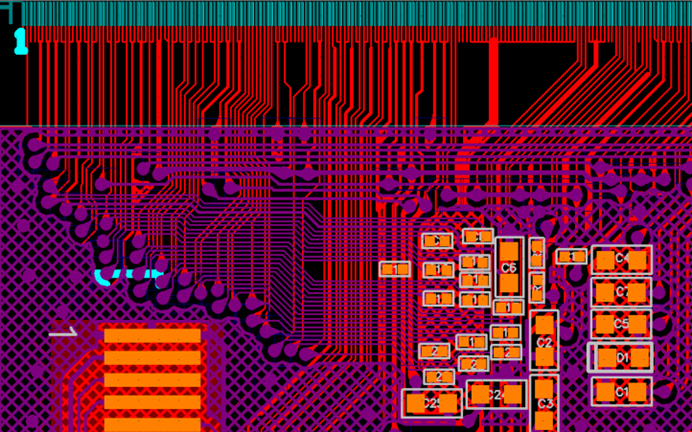
History of PCB in China
In 1956, PCB development began in our country.
In the 1960s, single panels were produced in batches, double-sided panels were produced in small batches and multilayer boards were developed.
In the 1970s, due to the limitation of historical conditions at that time, the development of printed board technology was slow, making the whole production technology lag behind the advanced level of foreign countries.
In the 1980s, advanced production lines of single-sided, double-sided and multilayer printed boards were introduced from abroad, which improved the production technology level of Chinese printed boards
In the 1990s, foreign printed board manufacturers from Hong Kong, Taiwan, Japan and other areas came to set up joint ventures or sole proprietorship factories in China, which rapidly progressed the output and technology of Chinese printed boards.
In 2002, China became the third largest producer of PCB.
In 2003, the output value and import and export value of PCB both exceeded 6 billion US dollars, surpassing the United States for the first time and becoming the second largest PCB output country in the world. The proportion of output value also increased from 8.54% in 2000 to 15.30%, nearly doubling.
In 2006, China replaced Japan, becoming the world’s largest output value PCB production base and the most active country in technology development.
Scale anddistribution of global PCB output value
Prismark’s report noted that the global PCB market’s output growth slowed to 1% to $81.741 billion in 2022 due to tightening global financial conditions, the Russia-Ukraine conflict, US export controls, energy market turmoil and currency changes caused by the appreciation of the US dollar.
In 2022, mainland China’s PCB output value reached $43.553 billion, accounting for 53.28% of the global PCB market value in 2022. Asia’s (excluding mainland China and Japan) output value was the second highest at $25.652 billion, accounting for 31.38%; followed by Japan, the Americas and Europe with 8.91 percent, 4.12 percent and 2.31 percent, respectively. The PCB industry belongs to the basic industry of electronic information product manufacturing, which is greatly affected by macroeconomic cyclical fluctuations. Currently, global printed circuit board manufacturers are mainly distributed in mainland China, Taiwan, Japan, South Korea, the United States, Europe and Southeast Asia.
The Chinese PCB industry is the largest production base in the world. The domestic printed circuit board industry is increasingly affected by changes in the international political and economic environment. Due to concerns about global inflation, economic recession and other factors, facing a weak global economic outlook, the PCB industry is expected to face challenges of weak demand, high inventory adjustment, oversupply and fierce competition in 2023. The impact of multiple factors is likely to significantly curb new PCB industry demand in the first half of 2023. Until the economic situation recovers by the end of 2023 and 2024, Prismark forecasts a 4.13% year-on-year decline in global PCB output in 2023.
Provincialdistribution of PCB manufacturers in mainland China
According to the PCB Research Institute of Zhanxin Industry Research, Guangdong is still the largest PCB production base among the 22 provinces and municipalities with PCB distribution in mainland China, with 1,437 enterprises, accounting for 60.6% of the total.
Jiangsu, Zhejiang and Jiangxi are among the provinces with more than 100 PCB manufacturers. There were 341 enterprises in Jiangsu, accounting for 14.4%; Zhejiang had 108 enterprises, accounting for 4.6%; Jiangxi had more than 130 enterprises, accounting for 4.3%.
Globalprinted circuit board market distribution and overview
1. PCB has abroad global market space
Driven by intelligent, low-carbon and other factors, PCB downstream application industries such as 5G communication, cloud computing, smart phones, smart cars and new energy vehicles are expected to thrive, and the booming development of downstream application industries will drive the continuous growth of PCB demand. According to Prismark, the total output value of the global PCB industry will grow by 4.2% in 2022. The global PCB market will maintain moderate growth in the next five years, with a CAGR of 4.6% from 2021 to 2026.

2. The globalPCB industry is transferred to Asia, especially to mainland China
The PCB industry is widely distributed around the world. Developed countries like the United States, Europe and Japan started early, utilizing advanced technology and equipment to achieve considerable development. Before 2000, America, Europe and Japan accounted for more than 70% of global PCB production output value, being the most important production base.
In the past two decades, relying on Asia’s advantages in labor, resources, policies, industrial clustering and other aspects, especially mainland China, global electronic manufacturing capacity has shifted to mainland China and other Asian regions. With the shift of the global industrial center to Asia, the PCB industry presents a new pattern of manufacturing centers in Asia, especially mainland China. Since 2006, mainland China has surpassed Japan to become the world’s largest PCB production region, ranking first in the world in both output and output value of PCBs.
As the largest production region of the global PCB industry, mainland China’s proportion of the total global PCB output value has increased from 8.1% in 2000 to 54.6% in 2022, while the proportion of America, Europe and Japan has declined significantly, and the PCB industry in mainland China and other parts of Asia has developed rapidly.
3. Productstructure of global PCB segmentation
According toPrismark, the global market structure of PCB segment products in 2022 is asfollows:
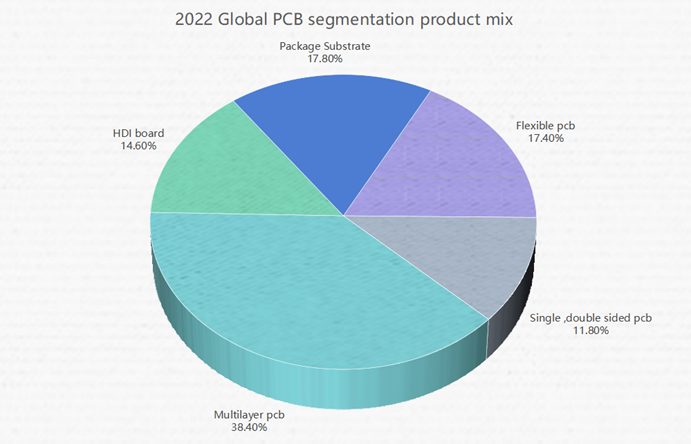
Rigid PCB is the largest market size, in which multi-layer boards account for 38.4%, single and double panels account for 11.8%; The second is the packaging substrate, accounting for 17.8%; Flexible boards and HDI boards accounted for 17.4% and 14.6% respectively.
With the rapid development of electronic circuit industry technology, component integration functions are becoming more extensive, and the requirements for high density of electronic products are more prominent. In the next five years, driven by consumer electronics, automotive electronics and computers, packaging substrates, HDI boards and multi-layer boards will grow rapidly. According to Prismark, packaged substrates will grow at a compound annual growth rate of about 8.3% from 2022 to 2026, leading the PCB industry. The compound annual growth rate of HDI boards was 4.9%.
4. Global PCB downstream application field
The global PCB downstream application market is widely distributed, mainly including communications, computer, consumer electronics, automotive electronics, server and data storage, military aviation, industrial control, medical devices and other fields. The vigorous development of the electronic information industry is an important boost to the development of the PCB industry. With the development of next-generation information technologies such as big data, cloud computing and 5G communication, the demand for servers and data storage is growing rapidly. According to Prismark, the global output value of PCBS in the server and data storage sector was $5.893 billion in 2020 and is expected to reach $8.859 billion in 2025, with a compound annual growth rate of 8.5%, faster than other applications.
Here is a summary of the key points regarding PCB history, development and industrial distribution:
PCB History and Development:
- Printed circuit boards were first invented in 1936 and used in radio devices.
- In the 1940s and 1950s, PCBs were adopted by the military and then approved for commercial use.
- In the 1960s, double-sided PCBs were developed and mass produced.
- In the 1970s, multilayer PCBs became popular and production focused on high precision, density and reliability.
- In the 1980s, surface mount PCBs replaced plug-in PCBs and became the mainstream.
- Since the 1990s, chip scale packaging and organic laminate materials were rapidly developed for PCBs.
PCB Development in China:
- PCB development began in China in the 1950s but lagged behind foreign countries due to historical conditions.
- In the 1980s, advanced production lines were introduced from abroad which improved China’s PCB production technology.
- Since the 1990s, foreign PCB manufacturers set up factories in China, rapidly advancing Chinese PCB output and technology.
- Since 2006, China has surpassed Japan to become the world’s largest PCB production base.
PCB Industrial Distribution:
- The PCB industry is widely distributed around the world, with developed countries starting early and using advanced technology.
- Since 2000, PCB production has shifted to Asia, especially China, due to advantages in labor, resources and policies.
- China has become the largest PCB production region, accounting for over 50% of global PCB output value.
- Hope this helps summarize the key points regarding PCB history, development and industrial distribution mentioned! Let me know if you need anything else.